
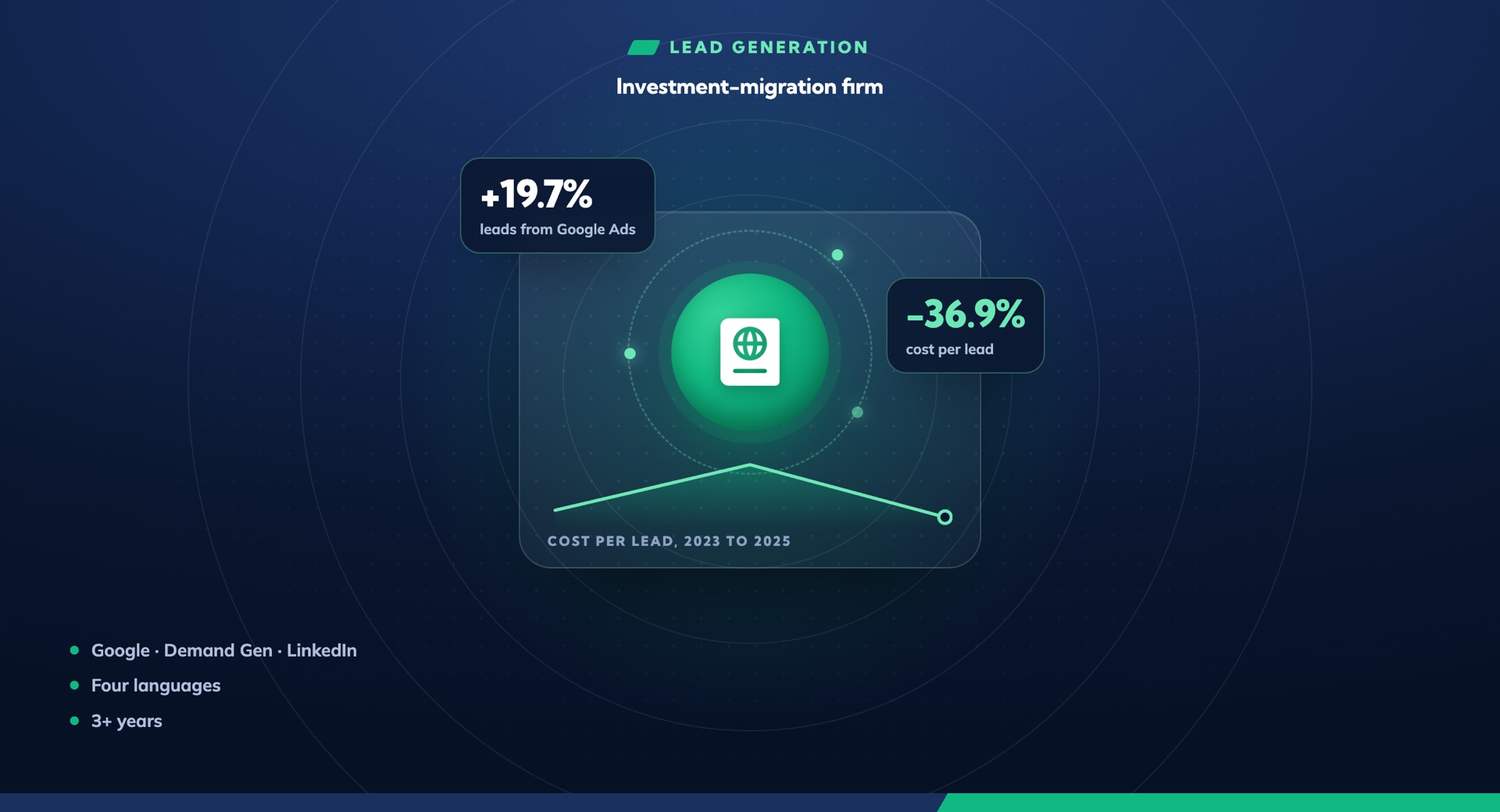
An investment-migration firm sells second citizenship and residency programmes to wealthy families in more than a dozen markets. Every lead is a family weighing a major decision, so every lead costs real money to qualify. We ran its search, video and LinkedIn acquisition in three languages for more than three years.
The situation
Thousands of leads, and very few worth a call
The account we inherited had fifteen campaigns, an optimisation score of 58% and disapproved ads, and its markets and languages overlapped. It produced volume, but the sales team spent its time on enquiries that were never going to become investors.
The firm did not need more form-fills. It needed the ad platforms to learn what a qualified investor looks like.
What we did
From form-fills to qualified investors
-
Rebuilt without losing the learning
Ads were rebuilt inside the live campaigns rather than starting new ones, so no learning was lost. Markets and languages were separated, and every programme got its own ad group.
-
Moved the upper funnel to Demand Gen
Display gave way to Demand Gen by market. By the latest full year three Demand Gen campaigns were among the cheapest sources of leads in the whole account.
-
Taught the platforms what quality means
Household-income and device targeting, bot-IP exclusions, lookalikes built from closed deals, and lists of converted clients sent back as customer matches.
-
Fed the CRM’s verdicts back to Google
Each campaign was judged on the leads the sales team qualified in the CRM, campaign by campaign, so budget followed qualified investors.
-
Cleaned the domain for organic search
Three backlink audits, three disavow rounds (2,270 domains by the last one), a keyword-gap study against leading competitors and a 473-URL redirect map for the site migration.
-
Timed campaigns to the business
Campaigns ran around programme price rises, seasonal offers and market-specific messages, alongside LinkedIn programme campaigns for professional audiences.
Results
Cheaper leads while the market got more expensive
In the latest full year Google’s own category data showed click costs rising 32%, with fewer clicks available. In the same year this account bought more leads with less money.
The latest year against the market
Search, cleaned
A healthier domain in nine months
Toxic backlinks before and after
What made the difference
The cheapest lead is the one the platform never shows an ad to. Once the CRM’s verdict flowed back into Google, the account stopped paying to find people who would never sign.