
The sister store of a dealer group we already ran: one lot, the same credit-challenged buyers shopping in two languages, and a fraction of the budget. Efficiency mattered more than reach. We launched it from small test budgets and built it into one of the cheapest lead engines we run.
The situation
A new store with a small budget and the same hard buyer
The store started its marketing with nothing running: no audiences, no history and a Google account that was barely producing. Its buyers are the same as the group’s, people with bruised credit, but it had one lot and a budget built for testing, not scale.
So the question was never how to buy more reach. It was how to borrow everything the bigger store had already learned, and spend less to find each buyer.
What we did
Launch small, then borrow what works
-
Tested every platform at small stakes
Five platforms went live with test-sized budgets, each with ad sets in both languages, carousels and video, all running in sales hours only.
-
Scaled what earned it
By the end of the first year Meta carried the plan: a tight radius around the lot, six ads per language and copy rotated by results.
-
Rebuilt Google around lead forms
Performance Max, Search and Demand Gen were rebuilt, firing on the CRM quick-form. Google went from almost no conversions to 1,457 in a single quarter.
-
A premium line with its own offer
A separate line for newer, higher-priced stock, with its own carousels and videos, so the store could sell up without confusing its main offer.
-
Shared data across both stores
The owner’s two dealerships pool their graded CRM data. The best buyers from both became the seed audience, which helped the smaller store grow on proven data.
Meta cost per lead, from launch scale to the latest full year
Results
More cars from less spend
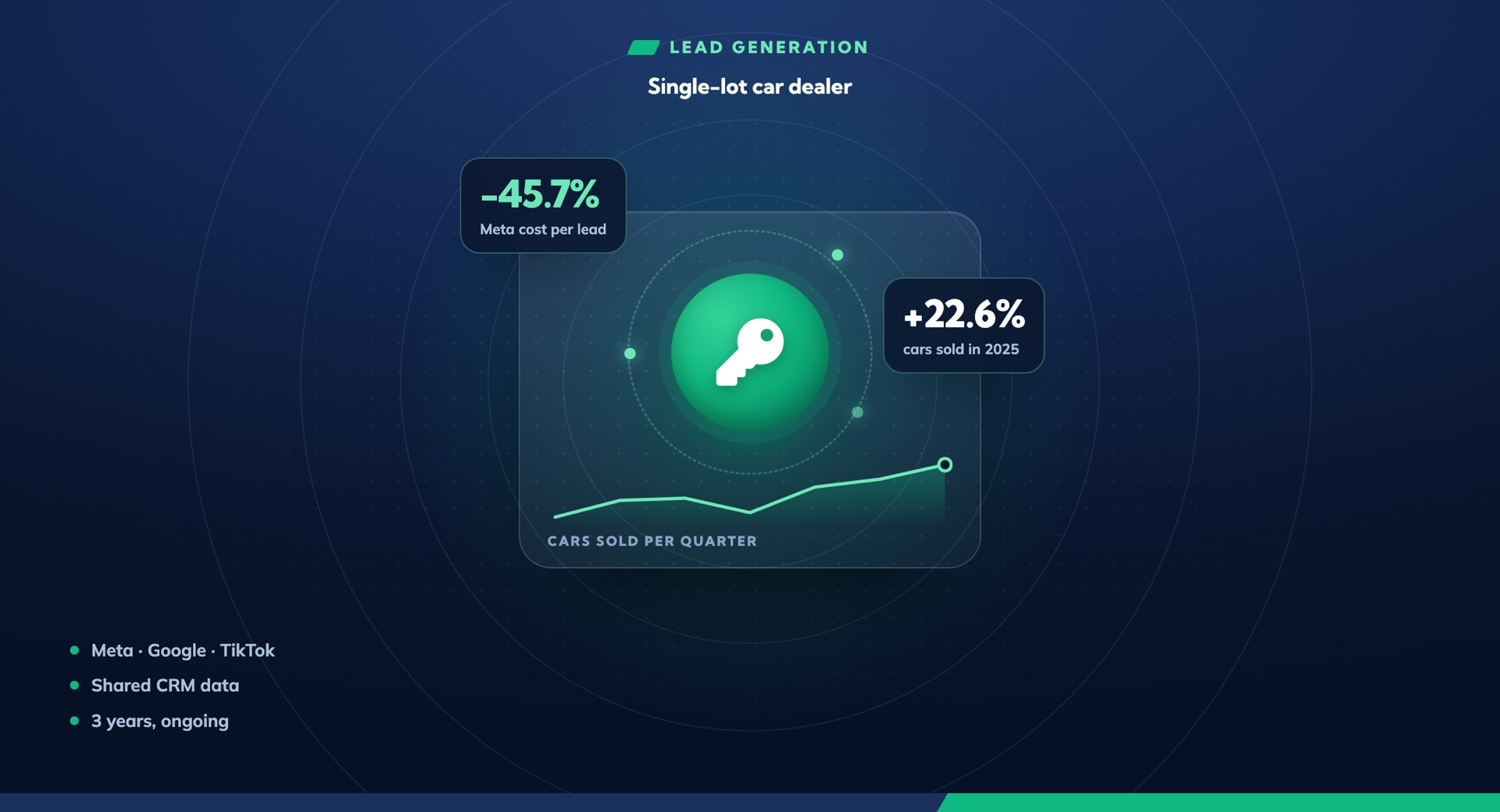
In the latest full year the store spent 22% less on Meta and got 43% more leads. Google conversions rose 165% at $5.84 each, and the CRM recorded 23% more cars sold. The following quarters kept climbing.
Cars sold per quarter
The work
Inventory first, always



What made the difference
The smaller store did not need its own playbook. It needed the bigger store’s data. Shared, graded buyer lists turned two separate ad budgets into one learning system.