

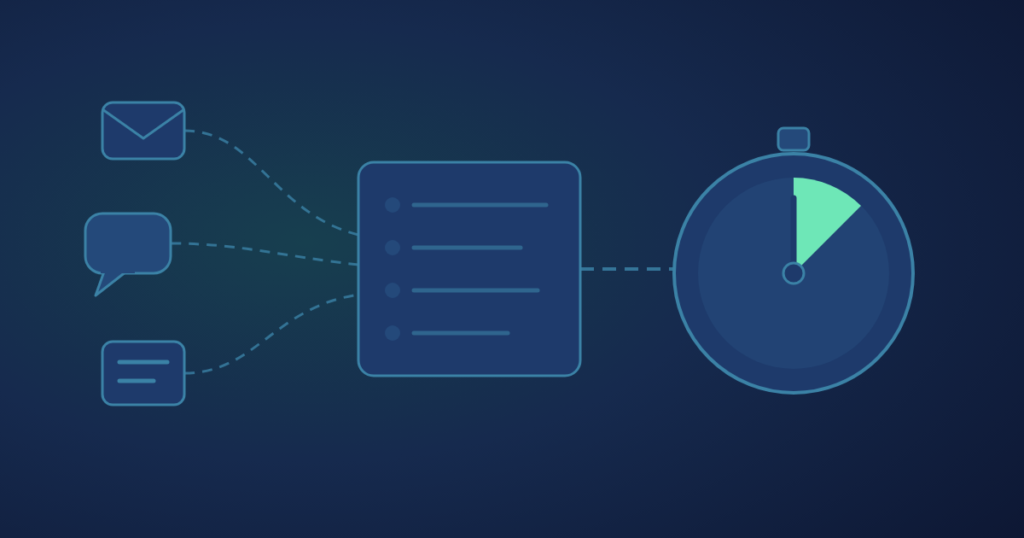
Reply within minutes, not hours: the first business to respond usually gets the first real conversation. Make it reliable by sending every lead to one list, alerting a named person at once, sending an automatic first reply by WhatsApp, SMS or email, and following up on a fixed schedule until there is an answer.
Speed to lead is the time between an enquiry arriving and a person from your business making contact. It is one of the few sales numbers you control completely, and it rarely needs more staff to improve. It needs routing, a first reply and a schedule.
What the research says about response time
The best-known study found that contact within the first hour made a meaningful conversation far more likely than contact even an hour later. The work, published in Harvard Business Review as The Short Life of Online Sales Leads, looked at 1.25 million sales leads and defined qualifying a lead as having a meaningful conversation with a key decision maker.
The same article describes an audit of 2,241 companies that each received a test enquiry from their website. The spread of replies shows how wide the gap between businesses can be.
These figures come from many businesses across several industries, and your own numbers will differ by product and channel. The direction is what matters: interest is highest at the moment someone asks, and it fades as the hours pass and other businesses reply first.
Why replies are slow: five inboxes, after hours, no owner
Slow replies usually come from how leads arrive, not from how hard people work. Three patterns account for most of the delay.
Five inboxes
Lead ads, website forms, WhatsApp, direct messages and calls each land somewhere different. Each one gets checked when someone remembers to.
After hours
Enquiries also arrive in the evening and at weekends, when people have time to browse. Nobody sees them until the next working morning.
No owner
When a lead belongs to “the team”, each person assumes someone else has it. The lead waits, and nobody notices it waiting.
A travel agency we work with had all three. Requests arrived in comments, messages and calls, with dates, group sizes and budgets scattered across them, and nobody could say which enquiries had been answered.
One list for every lead
Every enquiry, from every source, should land in one list where each lead has an owner, a status and a time stamp. That list can be a CRM or a shared sheet. What matters is that nothing lives only inside an ad platform or one person’s phone.
Leaving leads inside the ad platform also carries a practical risk. Google’s help page on lead forms says plainly that Google Ads stores leads for 60 days, so download your data often, and it lists webhooks and CRM connections as ways to send leads out automatically.
Each lead in the list carries
- Source, campaign and form
- Time the enquiry arrived
- Time of the first human contact
- A named owner and a backup
- A status: new, contacted, booked, won, lost
Signs the list is not working yet
- Leads downloaded once a week as a file
- Some sources never reach the list
- Status changes live in chat threads
- Nobody can say who owns a lead
The travel agency moved to a single form for every trip and one shared sheet with a status column, so every request had an owner and a next step. The result was 531 trip enquiries in one organised queue.
Tip: the alert matters as much as the list. When a lead arrives, the named owner should get a notification on their phone at once, and the backup should get one too if nobody has touched the lead after a set time.
The first reply: automatic, then human
An automatic reply confirms the enquiry within seconds; a person then makes the real contact. The automatic message buys time and sets expectations. It does not replace the conversation.
The automatic reply
- Thanks them by name and repeats what they asked about
- Says who will contact them and roughly when
- Gives one useful thing: a price guide, a link, a next step
- Asks one easy question they can answer in a tap
The human contact
- Comes from the named owner, not a shared inbox
- Picks up from what the automatic reply said
- Qualifies with two or three questions
- Ends with a booked next step and a time
Write the automatic reply as a person would, short and specific. A message that says “We received your request” is a receipt. A message that says “Thanks for asking about the family package. Our trips adviser will call you within the hour; which time suits you?” starts the conversation.
The automatic reply holds the door open. A person still has to walk through it.
A follow-up schedule that does not annoy
Plan several attempts across about a week, on more than one channel, each with a reason to reply. People miss calls for ordinary reasons, so one call followed by silence ends many conversations before they start.
| When | Channel | Purpose |
|---|---|---|
| Minute 0 | Automatic WhatsApp, SMS or email | Confirm the enquiry, name the owner, ask one easy question |
| 5 minutes | Phone call from the owner | Qualify and book the next step while interest is fresh |
| Same day | Second call, then a short message | Try a different time of day; say how to reach you |
| Day 1 | Message or email | Answer the question they are most likely to have |
| Day 3 | Call, then message | Offer a specific time slot or a short next step |
| Day 7 | Message or email | Close the loop politely and leave the door open |
Each message should add something: an answer, a price guide, an available slot. A follow-up that only says “just checking in” gives people nothing to reply to. After day 7, leads who have not answered move to a slower nurture sequence rather than being deleted.
Buying decisions can take longer than the first conversation. At a used-car dealer group we work with, the average time from lead to sale was 11 days, tracked in its CRM. A lead who goes quiet on day 2 may still be deciding, which is why the schedule runs for a week and the nurture after it. Our lifecycle and retention work covers that longer stage.
Have every enquiry answered in minutes
Our Lead Engine captures leads from every form and lead ad, scores and routes them to the right person, syncs them to your CRM with source and campaign, and sends the first follow-up message automatically. Your team keeps the conversations.
WhatsApp, SMS, call or email first
Reply first on the channel the lead used, then call if the enquiry needs a conversation. Someone who sent a WhatsApp message expects a WhatsApp reply; someone who filled in a form asking for a quote usually expects a call.
Suits leads who started the chat themselves. Rules apply to business messages, covered below.
SMS
Good for the automatic reply and short reminders. Keep it to one line and a clear sender name.
Phone call
The quickest way to understand the need and book the next step. Pair a missed call with a message.
Carries prices, brochures and links. Slower to be read, so rarely the only channel.
WhatsApp has specific rules for business messages sent through the WhatsApp Business Platform. When a user messages you, Meta’s developer documentation says a 24-hour timer called a customer service window starts, and while it is open you can send free-form replies. When the window closes, you can only send pre-approved template messages, and each template must be categorised as authentication, marketing or utility.
Worth knowing: a lead who filled in a form has not messaged you on WhatsApp, so no window is open. A first WhatsApp message to that lead has to be an approved template. Write and submit your templates for approval before the campaign starts, not on the day the first lead arrives.
For SMS and calls, check the consent rules that apply to your business and keep a record of how each lead agreed to be contacted.
Measuring response time every week
Measure the time from enquiry to first human contact, for every lead, and review it once a week. The automatic reply does not count; the number that matters is when a person first spoke or wrote to the lead.
- Log two time stamps per lead When the enquiry arrived, and when the first human contact happened. Most CRMs record both; a sheet can too.
- Split by hours Report response time for staffed hours and after hours separately, so one does not hide the other.
- Look at the median and the slowest The median shows the usual experience. The slowest ten leads show where the routing breaks.
- Count attempts How many contact attempts each lead received before an answer, or before the schedule ended.
- Compare by owner and source A slow source often means its leads never reach the list. A slow owner may simply have too many.
- Fix one thing Change one routing rule, alert or template each week, then check the number again next week.
The used-car dealer group shows one practical choice: its ads run only in sales hours, so a rep can call back while the buyer still has the phone in hand. If you cannot staff the evenings, that is one way to match lead flow to the hours someone can answer. The other is a clear automatic reply and a first call early the next morning.
0 of 8
If you would rather set this up yourself, our speed-to-lead playbook includes 44 templates, a 14-day call, text, WhatsApp and email cadence, and a lead tracker that works out minutes to respond for each lead. For why some leads never answer at all, see our guide on why leads stop answering, and for how we run campaigns built around qualified leads, see lead generation.
What owners ask about speed to lead
Is an automatic reply enough on its own?
No. It confirms the enquiry and sets expectations, but most leads still need a person to answer questions and agree a next step. Treat it as the first step of the schedule, followed by a call or message from the named owner.
What if leads come in at night?
Send an automatic reply that says when someone will be in touch, then make the first call early the next working morning. If night leads are a large share, consider running ads mainly in the hours your team can answer.
How many times should we follow up?
Plan around five or six attempts across about a week, mixing calls and messages, each with a reason to reply. After that, move the lead to a slower nurture sequence instead of dropping it.
Can a small team keep up?
Yes, if the routing does the sorting. One list, automatic alerts and a written schedule let two or three people handle a steady flow, because nobody has to check several inboxes or guess who owns a lead.
Should salespeople call or message first?
Match the channel the lead used: reply to a WhatsApp chat on WhatsApp, and call a form lead who asked for a quote. A short message straight after a missed call gives them an easy way to reply.